
Prague Airport Express
“Airport Express – Proposal for Connecting High-Speed Rail Lines to International Airports in the Czech Republic”** was prepared in April 2025 by Martin Hausenblas and a team from the Institute for Sustainable Infrastructure.
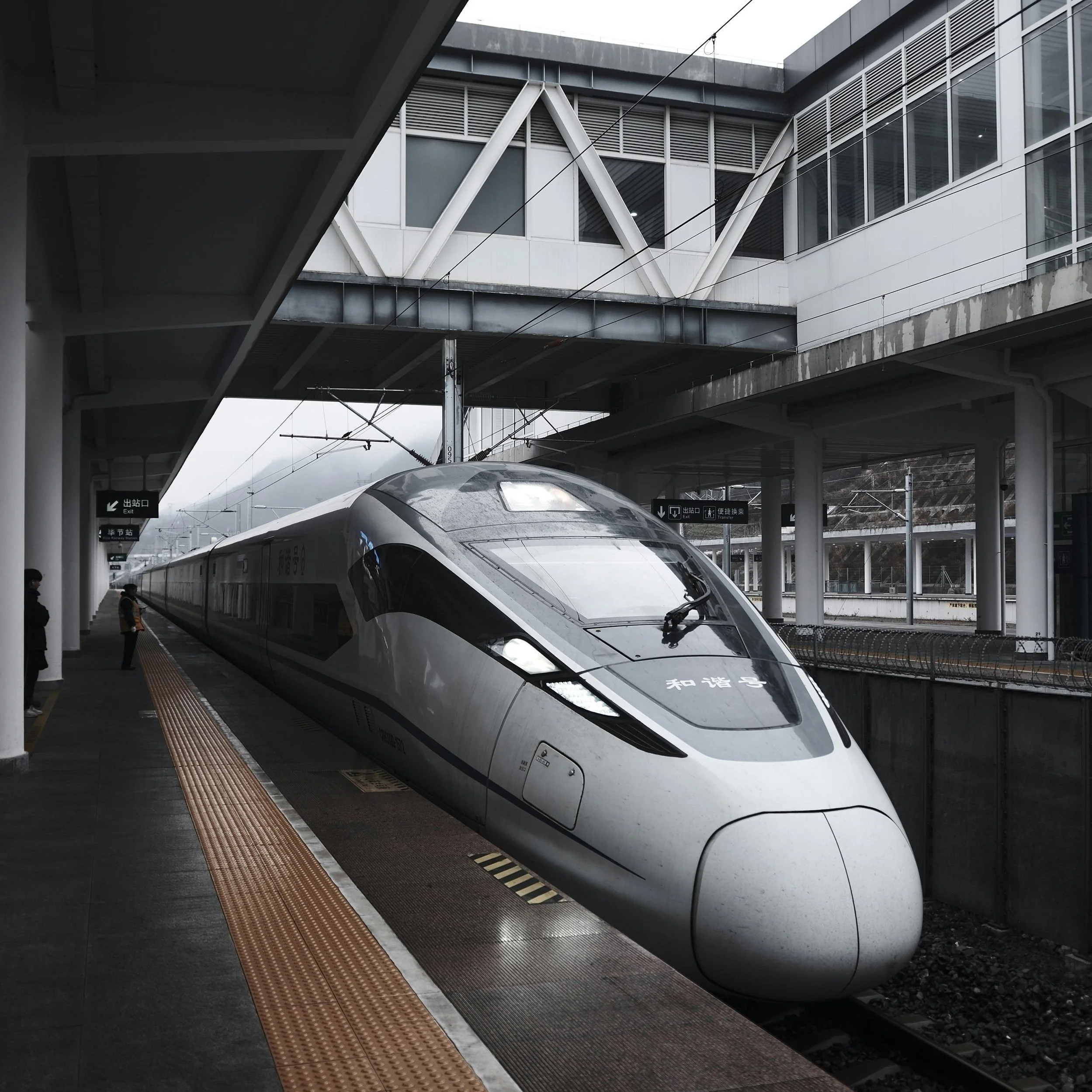
Thesis: Super-mobile people as the driving force behind the economy
The authors emphasize that highly mobile executives are a key driver of the economy and that companies will choose to locate their headquarters where their management can travel quickly and comfortably. Connecting Czech airports to the high-speed rail network by 2040 is not just a matter of complying with European directives, but above all in our own best interest.
Václav Havel Airport in Prague is cited as an example: if it is directly connected to high-speed rail lines, its catchment area will expand significantly, the airport will begin serving millions more passengers per year, and it will become attractive for new nonstop flight destinations. This would encourage many companies to relocate their headquarters to the Czech Republic and pay taxes here.
A shift in the modal split in favor of rail would also have a positive impact on automobile traffic in Prague. In addition, the city would gain a new northwest-bound high-speed rail corridor, which would enable direct connections to Plzeň, Karlovy Vary, and Kladno. Another benefit would be a backup route for freight transport, which is also important from the perspective of military transport.
Design Specifications
The Airport Express is designed for passengers at Václav Havel Airport (LVH) who need a quick connection to the high-speed rail network to continue directly to their final destinations. The goal is to achieve a travel time of up to nine minutes between Prague’s Main Station and the airport, including a stop at Můstek; the proposed service interval is 15 minutes.
The project is expected to provide a significant boost to LVH’s development by expanding its catchment area to include major cities such as Dresden, Brno, Ostrava, and other metropolitan areas. This would significantly increase the airport’s appeal to international airlines.
The proposed solution has the potential to significantly shift the modal split in favor of rail transport. At the same time, it increases the capacity of Prague’s Main Station by allowing certain lines from the east—which currently terminate in Prague—to be rerouted to LVH; the staging yard behind the airport would be used for this purpose.
The proposal builds upon and supplements existing development plans for high-speed rail lines (VRT), commuter trains, and the Buštěhrad connector. It is designed to integrate with the new Terminal 2 at the airport and minimize transfer times. The Airport Express stops will be connected to Metro lines A, B, and C via the Můstek and Prague Main Station stops.
The project reflects Regulation (EU) 2024/1679 of the European Parliament and of the Council on the TEN-T network, which requires member states to connect airports with more than 12 million passengers per year to high-speed rail by 2040 (which applies to Václav Havel Airport). Smaller airports, such as Brno and Ostrava, are to be connected by 2050.

Prague Airport Express (LE Praha) – Technical Description of the Route
Given the terrain conditions, the entire proposed route is to run through a tunnel. It will start at the Praha-Zahradní Město railway station and then run at a gradient of approximately 10 ‰ to the third underground level of the Praha Main Station, where a through-configuration with four platform edges, each 420 meters long, is planned.
At the same time, a new underground station, Praha-Můstek, will be built, which will be connected via a pedestrian walkway to Metro Lines A and B. The station platforms are to be designed similarly to regional transit stations in the Prague metropolitan area, i.e., to accommodate two four-car trains with a total length of 220 meters.
In the area of the Malostranská metro station, the Airport Express line will pass under the existing metro tunnels and then, due to the geography of the area, will run in an almost straight line toward the airport, taking into account the Divoká Šárka Valley. The route will then climb at a constant gradient of approximately 20‰ until it reaches the airport grounds. The project is supported by Václav Havel Airport Prague, ROPID, and IDSK. The new western extension of the high-speed rail line from Prague will also provide an alternative connection to the Karlovy Vary Region (Karlovy Vary, Cheb) and a link to Germany.

LE Prague Operating Concept – Main Line
In its standard mode of operation, the Airport Express will run between Prague’s Main Station and the airport with a single stop at Můstek. The target travel time is nine minutes. To maintain a 15-minute headway, two train sets will be required, which will turn around at the airport on Track 52; the estimated entry speed is 80 km/h and the departure speed is 60 km/h.
For select airlines, the possibility of checking baggage at the Main Train Station is being considered, which will shorten and simplify the journey for passengers. The infrastructure’s capacity is designed to allow for the addition of up to eight more trains per hour to the schedule, which could arrive from the direction of Zahradní Město—for example, routes from České Budějovice, Brno, or Hradec Králové.

LE Prague Operating Concept – Expanded Routing
Tracks 51 and 52 at the airport will be available primarily for the quick turnaround of Airport Express trains; other trains will use Track 2 for passenger disembarkation and Track 1 for boarding. Turnarounds will be performed via the siding behind the airport.
As a priority, a route from České Budějovice to the airport should be established, which would also stop at Můstek, thereby partially offsetting the longer travel time between České Budějovice and Prague; the current option proposed by the Railway Administration does not meet the target travel time of one hour.
The second recommended route runs from Hradec Králové via the Pardubice Airport, which would create a direct rail connection between the two airports. High-speed lines from Moravia will also be integrated into the system via new, operationally reliable high-speed rail lines.

Business Concept
The investment costs for the Airport Express project are estimated at approximately 70 billion crowns as of 2025. The project is being considered for implementation as a PPP (public-private partnership). The business model is inspired by the Heathrow–Paddington line in London: boarding and exiting the Airport Express would incur a special surcharge; for calculation purposes, an approximate amount of 15 pounds per person (roughly 430 CZK) is used. Airport employees would use a separate entrance and would be exempt from this fee.
Assuming a 60% modal split in favor of the Airport Express and an annual ridership of 35 million passengers, fare revenue would amount to approximately 9 billion crowns per year. With the current annual ridership of 19 million passengers (as of 2025), annual revenue would amount to approximately 4.9 billion crowns.
Brief Summary
The Airport Express is a strategic project designed to create an ultra-fast rail connection between Prague’s Main Station and Václav Havel Airport, with a travel time of up to nine minutes and regular 15-minute service. By connecting to the high-speed rail network and the Prague Metro, it would significantly expand the airport’s catchment area, increase its competitiveness, and improve mobility for residents and businesses alike. The project is technically designed as a route running entirely through tunnels with connections in the city center and is supported by key transportation institutions. Financially, it anticipates an investment in the tens of billions of crowns and a business model inspired by international best practices.