The beating heart of Europe is in the Czech Republic.
We want to be the continent's transportation, energy, and data hub.

The Czech Republic: The Beating Heart of Europe
The prosperity and sustainability of European society are based on cooperation and exchange. We need space for cooperation and a specific place for exchange.
It is no coincidence that the Czech Republic is called the heart of Europe. Trade routes have always passed through it, and the borders of the lands of the Czech Crown have remained more or less unchanged for over a thousand years. It is one of the safest regions on the continent. Far from the harsh elements of the north, the dangerous volcanic eruptions of the south, and with a historical experience that gives us the courage to defend ourselves against threats coming from the east.
The Czech Republic can be the heart of Europe if it opens itself up to Europe. We can be a hub for trade. We can be a safe destination for tourists. We can be a center for education, human rights, and the arts.
However, what will benefit not only us but all of Europe is if we become a hub for energy, transportation, and data.
The Mission of the Puls Institute
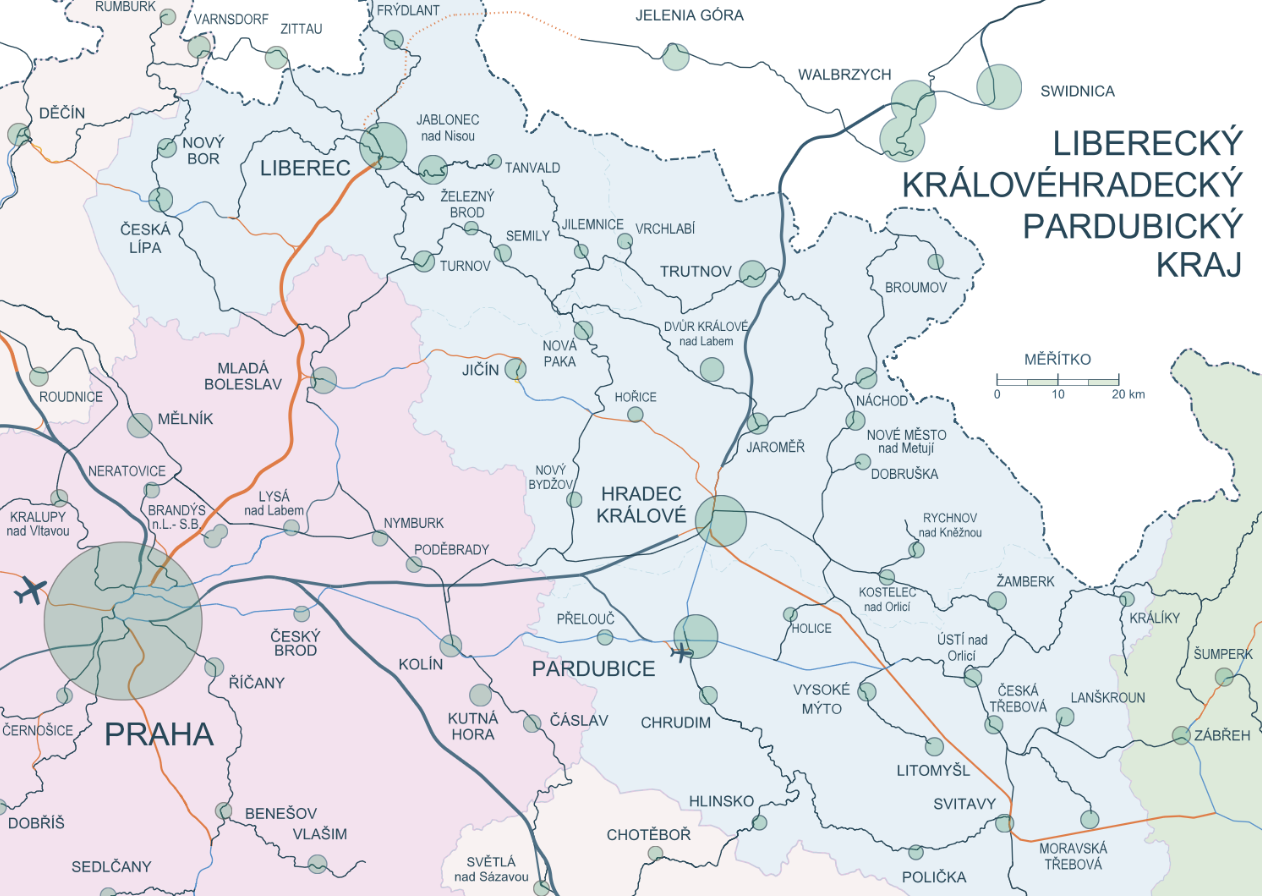
Our mission is to promote the construction of high-speed rail lines (350 km/h) in all regions of the Czech Republic so that every citizen can travel from any regional capital to Prague or Brno in one hour, and so that travel time between Warsaw and Munich, as well as between Berlin and Vienna, is reduced to three hours.
In the medium term, through 2030, we are focused on promoting:
-

the construction of high-speed rail lines in the Czech Republic so that, by 2035, every Czech citizen can travel from a regional capital to Prague or Brno and to an international airport within an hour. High-speed rail lines will also create safe corridors in the landscape for other purposes
-

the installation of HVDC (high-voltage direct current) cables for electricity sharing along high-speed rail lines, so that renewable electricity in the Czech Republic becomes available and 30% cheaper compared to the beginning of 2022
-

the installation of high-capacity optical cables along high-speed rail lines, which will make the Czech Republic a secure data storage hub for all of Europe and a center for the development of artificial intelligence
Our mission is rooted in the following goals:
Ensure that the High-Speed Rail Act is adopted by the end of the legislative session, or, if necessary, amend the Act on Linear Structures (No. 416/2009 Coll.) to a version that respects the benefits for all Czech citizens as well as for European cooperation in regional cohesion, support for collective defense, and the reduction of transportation emissions.
To gain the support of the majority of society for an ambitious plan to build high-speed railways and promote energy flexibility in the Czech Republic. To shift the public and experts’ perception of electricity imports from foreign sources toward a more positive view.
Reach a memorandum of understanding between the Czech Republic and the European Council on cooperation on a high-speed rail project and energy flexibility through the installation of HVDC cables. Secure the Czech Republic’s accession to the the North Sea Countries’ Memorandum on cooperation in the distribution of wind power through the Czech grid.
Ensure the construction of an AI gigafactory in the Czech Republic, the allocation of energy resources for its operation, and the operation of storage facilities and the associated data cable network.
The Puls Institute was founded in 2023 with the aim of promoting the vision of the Czech Republic as the heart of Europe and facilitating the construction of high-speed rail lines alongside high-voltage and data cables.
Its mission is to fulfill this vision independently, in the interest of the citizens of the Czech Republic and the EU, and in line with our values. To advance this vision, we collaborate with organizations, individuals, companies, and political representatives across as broad a spectrum as possible.
Our activities include the preparation of expert and analytical reports, raising awareness among policymakers and key stakeholders in the government, as well as communication and engagement initiatives aimed at the general public.
The Puls Institute is funded by both private and public sources and transparently lists all of its partners here on its website and in its annual report on relationships.
The Puls Institute was founded by entrepreneur and philanthropist Martin Hausenblas, former Minister of the Environment and diplomat Petr J. Kalaš, and communications expert and founder of the KONTRA studio Adam Ondráček, all of whom are also members of the board of directors. However, the Puls Institute has long been open to expanding its membership, network of collaborators, and board of directors so that, in addition to addressing issues related to transportation, energy, and data transmission, it can bring other aspects of the “Czech Republic at the Heart of Europe” vision to fruition.
Team
-

Martin Hausenblas
Martin Hausenblas is a Czech entrepreneur and philanthropist. He is a co-owner of Liftago and Malfini, a patriot of the Ústí region, and an advocate for the decarbonization of the energy sector and high-speed rail.
-

Petr J. Kalaš
Petr Kalaš is a Czech-Swiss expert on the environment, energy, and industrial planning, and a former Czech Minister of the Environment.
In 1968, he emigrated to Switzerland, where he worked at the Ministry of Foreign Trade from 1986 to 1994. Among other things, he coordinated cooperation with countries in Central and Eastern Europe. He later worked for the World Bank, for example on the implementation of the Kyoto Protocol on reducing greenhouse gas emissions.
-

Adam Panenka
Adam is a communications expert and the founder of the communications agency KONTRA. He studied journalism and innovation management at Charles University in Prague. Adam also spent three years as the strategic communications manager for the European Climate Foundation’s program for Central Europe.
-

Nikola Adamovská
Nikola Adamovská is a researcher in the field of global environmental policy. She earned her Ph.D. in International Studies and Diplomacy from the University of Economics, Prague. She served as a research fellow at the University of Glasgow and as the national coordinator for the intergovernmental organization Anna Lindh Foundation. Her research focuses on the localization of global climate norms, climate diplomacy, and the construction of meaning in social movements, using both quantitative and qualitative methods. She teaches courses on Transition Policy at Palacký University in Olomouc and Sustainable Development at the Anglo-American University in Prague.
Our Values
-

Sustainability
Global climate change is primarily caused by human activity, and it is our responsibility to develop transportation, industry, and energy in a way that does not contribute to it through emissions. We value our natural resources and biodiversity, and we want to preserve them for future generations.
-

Social Justice
Reducing disparities in society is the foundation for a sustainable way of life. Our goals contribute not only to reducing disparities across the European Union and fostering cohesion, but above all to narrowing the gaps between individual regions of the Czech Republic. However, the construction of linear infrastructure must always take place with the consent and participation of those it affects.
-

Competitiveness and Prosperity
We set our goals with the understanding that it is important for Czech citizens, institutions, and businesses to have long-term opportunities to develop, learn, and improve in terms of satisfaction, performance, and resource availability.
-

Safety and Stability
We want to capitalize on our location within Europe and our history, which is rooted first and foremost in maintaining long-term relationships. As a small country, the Czech Republic needs to establish anchors around the world, whether through our membership in the North Atlantic Treaty Organization or the European Union. Our goals contribute to more firmly establishing the Czech Republic as the center of Europe.
News







Publications






The Puls Institute in the Media